Stop paying for wasted energy.

We find the waste in your commercial building, prove the savings on your own equipment, and install nothing until the number is real.

To Dan · (864) 777-0688

Opens in your messages, ready to send. Send message
A typical commercial electric bill, marked up the way we read it: the demand charge is set by your worst 15 minutes of the month, roughly 30% of the energy charge did nothing, and the 15-minute interval detail is what a real quote is built from. COMMERCIAL ELECTRIC SERVICE STATEMENT OF ACCOUNT SPECIMEN ACCOUNT ····4471 RATE SCHEDULE · GS-2 PERIOD · JUL 01–JUL 31 METER · 2K-88146 Customer charge 88.00 Energy charge · 148,320 kWh 12,458.88 Fuel cost adjustment 1,036.24 Demand charge · 412 kW 7,580.80 Power factor adjustment 312.40 Taxes and riders 1,462.11 TOTAL DUE $22,938.43 INTERVAL DATA ON FILE · 2,976 READINGS · 15-MIN RESOLUTION ~30% OF THIS DID NOTHING SET BY YOUR WORST 15 MINUTES OF THE MONTH THE DETAIL WE QUOTE FROM
Exhibit A · a commercial bill, read the way we read it. Figures illustrative.1

About a third of the energy you buy does nothing.

That's the EPA's figure for the average commercial building.1 Most buildings have never had anyone qualified find out where theirs goes.

You've been pitched savings before, by someone selling a single product, with a payback chart from a different building. Saying no was the right call.

But the bill keeps arriving, and no building should pay, month after month, for energy that does nothing.

See why those pitches fail

Most energy vendors carry one product, so every building gets the same answer. The case study they show you is a different building's prescription. Nobody in that model is paid to measure your building first, so the waste survives the upgrade.

That is the entire difference here: the measurement comes first, and the fix is chosen to match what it finds, from more than four dozen technologies.

Fig. 01 · A dollar of commercial energy, at the EPA's average

You can hear it.

The compressor is the loud hum on your roof, and it eats more than 80% of a cooling unit's electricity. A healthy one cycles: hum, rest, hum, rest. A saturated one hums straight through, buying electricity that makes nothing colder.

A healthy unit

Hum, rest, hum. The rest is the sound of money staying yours.

A unit paying for nothing

The hum never stops. That's the waste, out loud.

Simulated audio, tuned to the pattern, not a recording. The real test costs five minutes standing next to your own unit — it's on page 2 of the worksheet, further down this page.

We start with a diagnosis, not a product.

This company started from the same frustration: savings that only ever existed in the brochure. We didn't want to guess either, so we went and got the engineer national labs hired when a measurement had to be right the first time.

Cliff Suljak, Chief Materials Engineer, standing in a materials testing laboratory
Personnel file · C. Suljak · Chief Materials Engineer

Meet your diagnostician.

When the Department of Energy and the Department of Defense needed measurements right the first time, Sandia National Laboratories didn't put the contract out to bid. They handed it to Cliff Suljak.5

  • Sole sourceSandia National Laboratories: directed a 22-engineer team across four DOE and DOD facilities
  • Billionsin projects overseen; the $600M Salt River Project quality program was one of them
  • ASTMeight years co-writing the national standards other engineers are tested against
  • 3 emiratescalled in to assess national grid reliability for Dubai, Abu Dhabi, and Sharjah

Energy savings is a measurement problem before it is an equipment problem. He runs the measurement on your building, on your side of the table.

Selected work · file 1 of 5 · hover to hold

Sandia National Laboratories · DOE / DOD

Sole-source. Five years. Twenty-two engineers. Four national facilities.

Sandia didn't put this contract out to bid. They awarded it directly to Cliff, then watched him assemble and direct a 22-person engineering team across facilities in Albuquerque, Livermore, Tonopah, and Kauai: hundreds of task orders completed under Star Wars Program infrastructure. When the DOE and DOD need structural integrity assured, they don't shop around.

Salt River Project · Arizona

He built the quality control system from scratch. The industry copied it.

As Manager of the Materials and Quality Services Division, Cliff created a complete quality control infrastructure for one of the Southwest's largest utilities: metallurgical lab, nondestructive testing, failure analysis, predictive vibration monitoring. The innovations he introduced on the $600M program were later adopted by utilities across the country.

York International · Los Angeles County Courts

Northridge earthquake. County engineers on the other side. He won.

After the Northridge earthquake threatened the world's largest thermal storage system at the LA County Courts facility, York International hired Cliff on a sole-source basis to fix it. He performed the seismic stability analysis, delivered litigation testimony against the county's own engineers and consultants, and prevailed. Then he designed, fabricated, and personally oversaw installation of the custom seismic restraint system.

UAE National Power Grid · Dubai · Abu Dhabi · Sharjah

Three emirates. One grid. They called him in to assess all of it.

What began as a reactive power loss engagement across Dubai, Abu Dhabi, and Sharjah grew into a full operational assessment of the UAE's power grid. Cliff mobilized in-country for extended periods, consulting directly to utility authorities on grid reliability. When a nation's infrastructure is the project, the margin for error is zero.

ASTM · Standards Committee · 8 years

Eight years helping write the standards everyone else is tested against.

For eight years Cliff served on the ASTM committee developing test methods for leading-edge materials diagnostics: advanced composites and ultra-high-strength metals in extreme temperature environments. The methods he helped develop were adopted as national industry acceptance criteria for utility procurement.

Prefer to watch? The whole method in a 6-minute film, below

Three steps. The first two cost you nothing.

The first two steps are what we call The Exam: a diagnosis of your bill and your building, proven before anything is proposed.

  1. Send a year of bills and a few photos.

    Your last 12 months of electric bills, and every page of them, not the summary. The full year shows your seasons, and the detail pages carry the rate schedule, demand charges, and 15-minute usage a real quote is built from. Add phone photos of the nameplate on each HVAC unit. Still one email, and no site visit to start.2

    Two shortcuts, either works: most utility portals export all 12 months in one download, or a simple authorization lets us pull your usage data from the utility directly.2

  2. We prove your number on your own building.

    Seven days of metering before the work, seven days after, on your own equipment, witnessed by anyone you choose: your engineer, your accountant, your sustainability reviewer. Recognized protocols on request.8

  3. You decide.

    Keep what pays for itself, or walk away owing nothing.2

Fig. 02 · The Exam's proof window

The Floor

If we can't prove the savings, nothing is installed and you owe nothing.2

To Dan · (864) 777-0688

Opens in your messages, ready to send. Send message

Heating and cooling can be half your bill. We start there.

Half a bill deserves a whole prescription. The Exam matches the fix to the equipment you actually run: what's right for a simple on/off compressor is wrong for an inverter system, and some heat should never reach your HVAC at all.

20–55%off the HVAC portion of your bill, combined, and we quote the floor, not the peak.1

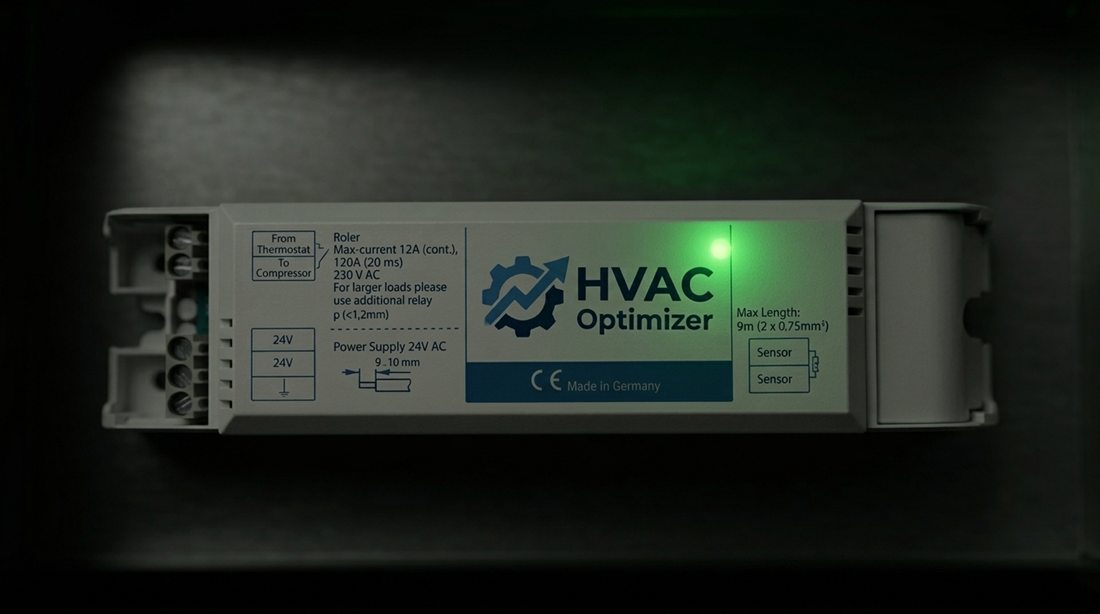
  • The HVAC optimizer control module, photographed on its mounting panel

    For simple on/off compressors · the most common systems

    The HVAC optimizer

    Learns how your building runs and shuts the compressor off the moment it stops doing useful work, while the fan keeps delivering the stored cold.

    15–30% less HVAC energy1

  • For aging units · any system type

    The coil treatment

    The waste no wash can reach: compressor oil bakes onto the inside of the coil circuit, year after year. One refrigerant-side treatment lifts it off, for the life of the unit.

    Recovers up to 36% of lost performance1, 12

  • A solar coil collector installed on a commercial roof, rooftop units behind it

    For inverter-type systems

    The solar coil

    Not a solar panel: a solar thermal retrofit that captures the sun's heat directly and puts it to work for the compressor, changing where the energy comes from.

    30–50% more efficient system1

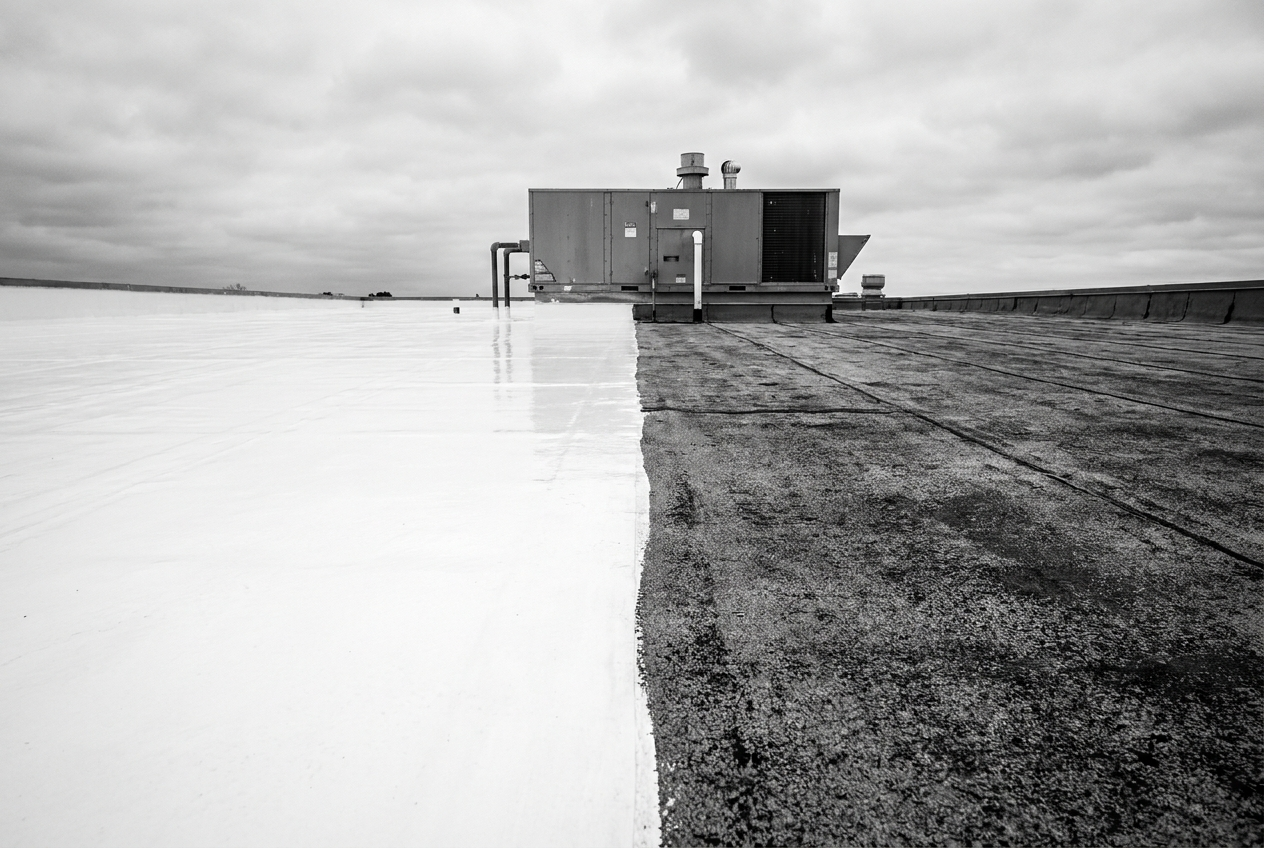
  • Illustrative: a commercial flat roof half-coated in a bright reflective thermal barrier

    For the building itself

    The thermal barrier

    Sprayed or membrane-applied where the diagnosis shows it pays, so the heat never reaches the equipment that would have fought it.

    Blocks up to 18 degrees before it gets in1

For true end of life · the flagship replacement

The SunCore

When a unit truly reaches end of life, this is what replaces it: a frontier-class packaged unit with solar thermal built in, dropping into the same footprint.

IEER 31 · COP 6 · half or more off heating and cooling energy1

And phase one's own metering data is what sizes the deeper fixes later, conditioning, storage, controls, refrigeration: the path past 30%, opened by your numbers, never by a brochure.1

How each fix works, in plain language →

Watch the whole method in six minutes.

How we find the waste, prove it on your own equipment, and install only what pays for itself. The deep weeds live here, told plainly.

Measured at 200+ named sites.

Metered results from the technologies we install, at the sites named, under their own conditions.1, 9 If a claim can't survive your accountant, we don't make it.

The ledger above is a live sample; hover to hold it still, click any entry for its context.

One page for everyone who has to say yes.

A manager finds us, an owner signs, a reviewer checks the math. This page is written to be forwarded.

If you run the building

Nothing breaks and nothing changes hands. The work happens on the units you already run, typically an afternoon each, with comfort held or improved.1, 12 Your incumbent HVAC contractor stays your contractor: we prefer to certify and work through them, not around them. Less compressor runtime and cleaner coils mean fewer breakdowns and fewer hot-room calls.

If you own the P&L

Every fix must clear a roughly two-year payback bar, or run cash-flow positive from day one, on your own numbers.1, 2 If we can't prove the savings, nothing is installed and you owe nothing. Every rebate, credit, and deduction your project qualifies for is found and filed for you.3, 4

If you answer for ESG or risk

Seven days of metering before and after, per unit, witnessed by any third party you choose. Recognized protocols on request: IPMVP Option C, ASHRAE Guideline 14.8 The result is verified kWh you can carry straight into energy and emissions reporting, not a marketing claim.

Forward this page to the person whose yes you need next, or download the one-page version (PDF) to put on their desk. It was written for them too.

Run your own number.

Two minutes, conservative by design. A model, not a quote; the exam confirms the real figure.1

Waiting isn't neutral.

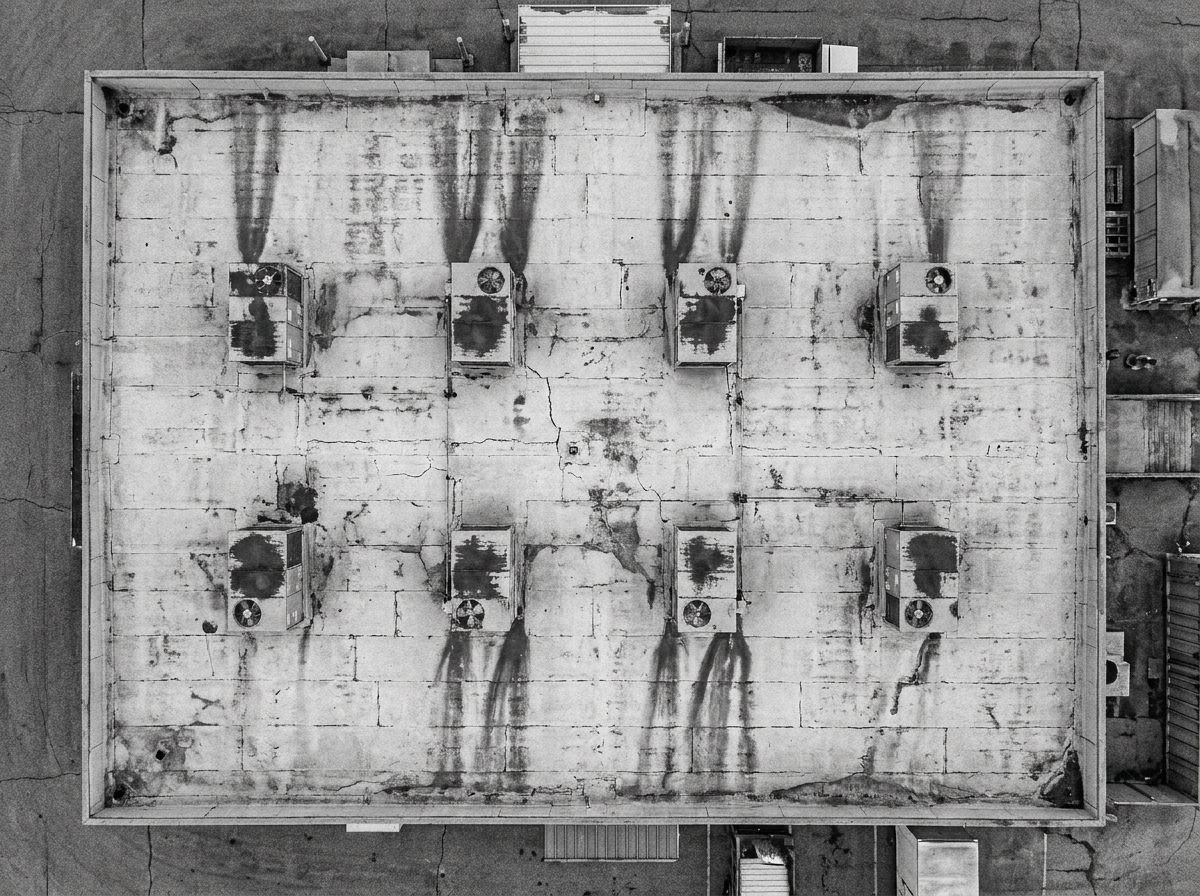
The same waste that pads the bill runs through your equipment and wears it out years early. Replacing an aged-out RTU fleet runs $260K to $480K per property.1 None of that appears on any bill until the day it all does.

Illustrative: overhead survey view of an aging commercial roof, oil and rust streaks running from each of its package HVAC units
Survey plate 1 · An aging fleet, streaking oil · The equipment doing the paying · illustrative

What it looks like when the number is real.

A lower bill, proven on your own meter and holding month after month.1 Equipment that outlives its replacement schedule instead of dying early.12 And the part people remember: walking into the next budget meeting with a number nobody can argue with.

Find out what your building is wasting.

Fifteen minutes tells you whether your building qualifies. The diagnosis is on us.2

To Dan · (864) 777-0688

Opens in your messages, ready to send. Send message
Meet the people behind the numbers
Daniel Gutierrez

Daniel Gutierrez

CEO + Founder

19 years connecting people, capital, and opportunity across 14+ industries. Former director of FDA-registered clinical trials. Works fee-for-performance.

Ronson Provido

Ronson Provido

Principal Engineering Advisor

20+ years in electrical engineering across design, commissioning, and project management, including LAX. Licensed PE, Title 24 and LEED qualified.

CJ Metz

CJ Metz

Strategic Account Manager

23+ years in technology leadership, sales, and consulting. Air Force veteran with major initiatives for Fortune 500 firms.

Pepper J. Matanga

Pepper J. Matanga

Partnerships & Business Development

25+ years leading P.E.P. & Associates, with partnerships from AT&T, Boeing, and NASA to the US Marine Corps and Navy.

Raul Solis

Raul Solis

International Market Development

A decade opening retail, commercial, and government channels in Mexican and South American markets.

The full record

Every result was measured at the named site under its own conditions; it is not a prediction for your building. Regional programs aggregate hundreds of additional sites into the 200-plus total.1, 9